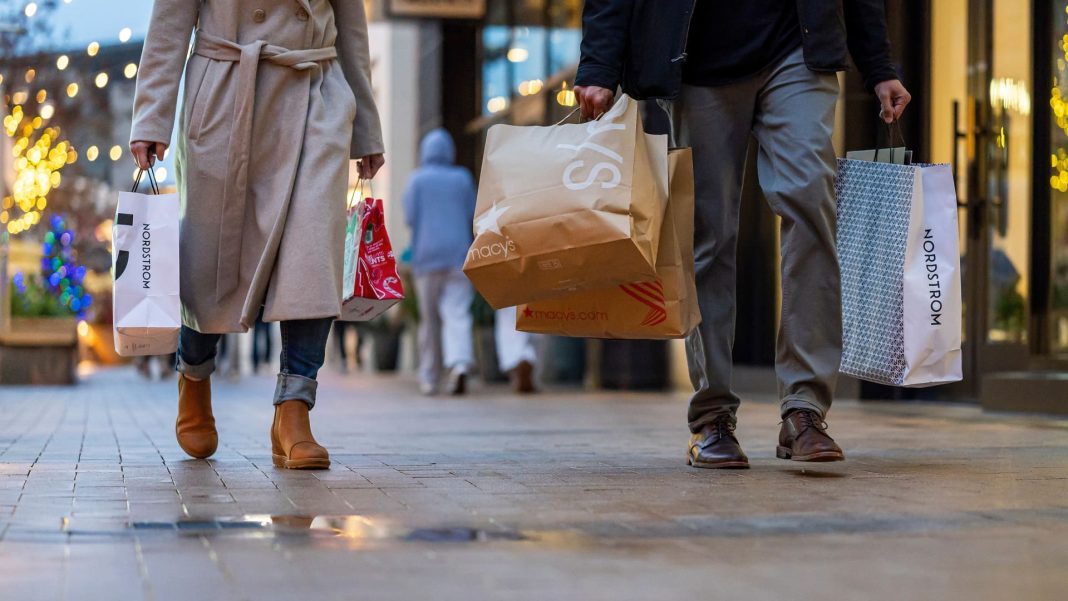

Shoppers carry Macy’s and Nordstrom bags at Broadway Plaza in Walnut Creek, California, US, on Monday, Dec. 16, 2024. The Bureau of Economic Analysis is scheduled to release personal spending figures on December 20.
David Paul Morris | Bloomberg | Getty Images
While the impact so far this year has been muted, tariffs are expected to catch up with prices consumers pay just in time for the holiday shopping season.
President Donald Trump’s tariffs on a plethora of items and individual countries, which started in April, have coincided with common inflation measures trudging along between 2.5% and 3% this year.
While economists don’t see a major spike coming in common measures such as the consumer price and the personal consumption price indexes, they expect the tariffs will keep those gauges elevated at a time when they otherwise would be moving lower.
“There have been some questions in recent months as to whether tariffs have led to higher inflation for consumers,” Bank of America economist Aditya Bhave said in a note. “We think there’s no debate — tariffs have pushed consumer prices higher.”
Tariff impacts have been muted so far as companies built up inventories ahead of the duties and absorbed some of the impact through compressed profit margins.
Bank of America, though, expects that tariffs will be adding about half a percentage point to the core PCE measure the Federal Reserve uses when assessing inflation. With tariffs, BofA estimates that the inflation rate would be 2.9% in September, so without them that would mean a measure closer to 2.4%. The numbers are similar to ones Fed Chair Jerome Powell cited Wednesday. The core PCE on an annual basis was 2.9% in August.
These percentage point differences matter to the Fed, which tries to keep core inflation, excluding food and energy, at 2%, a level it has been above since March 2021. Two Fed officials — regional presidents Jeffrey Schmid of Kansas City and Lorie Logan of Dallas — said Friday they did not agree with their colleagues’ decision Wednesday to lower the central bank’s key interest rate.
For consumers, they also matter. Bhave estimates that shoppers are bearing about 50%-70% of total tariff costs, with businesses bearing the rest.
Impact at the cash register
In real-world terms, that’s meant higher prices for things such as coffee, furniture and, recently, clothing prices, which jumped 0.7% in September, according to the Bureau of Labor Statistics. Even though they are minor components of the price indexes, they are items consumers buy frequently and can create perceptions about inflation, which can produce a self-reinforcing cycle that drives prices higher.
“Inflation in certain goods can have an outsized impact on consumer confidence, even if those items carry a negligible weight in the CPI basket,” TD Cowen analysts said in a note. Price increases in items such as eggs create “a constant, tangible feedback loop every week at the grocery store. Such items shape perception more than their statistical significance would suggest.”
The firm noted that this holiday season could see more of that sort of thing as artificial Christmas trees are almost all imported from China, which faces heavy costs under the Trump tariffs.
“While Artificial Christmas trees are not unique, they serve as a clear example of how high-tariff, seasonal goods can shape consumer perceptions of inflation,” Cowen said.
Had the duties been in place during the 2024 holiday season, shoppers would have spent an additional $40.6 billion, according to LendingTree estimates using data from multiple government and private sources.
LendingTree’s Budget Lab further estimates that some 70.5% of new tariffs were passed onto consumers in June 2025.
“That means that even more Americans would have had to fall back on credit cards and personal loans to help cover gift-buying expenses,” said Matt Schultz, the firm’s chief consumer finance analyst. “That’s the unfortunate reality that many people would have faced.”
Using the same estimates, LendingTree said the tariff cost comes to $132 per shopper.